

Emergency Fiber Splice Repair
Fiber line cut? Call now. We mobilize a splicer and a fully stocked splice trailer any hour, any day, to get your strands restored and your customers back online.
24/7 Emergency Fiber Repair
Line down right now? Call instead of filling out a form. We answer any hour and mobilize immediately.
What to do when a fiber line gets cut
Call us first, then stop work at the dig site. A cut fiber is an outage that bills by the minute, and the fastest path back to service is getting a splicer rolling while you are still assessing the damage. We answer 24 hours a day, and the person who picks up is someone who splices fiber, not a dispatcher reading from a script.
On that first call we want three things: where the damage is, roughly how many strands are involved, and who owns the cable. That is enough for us to load the right closures, pigtails, and hardware before we leave, which is usually the difference between one trip and two. If you do not know the strand count, say so. We would rather bring too much than discover a 288-count ribbon cable with a 48-count kit on the truck.
While we are en route, leave the cable exactly as it is. Do not pull the ends, do not cut back to clean them up, and do not tape them together. Every foot of slack you preserve is a foot we do not have to add back with a second splice point, and a cable that has been dragged out of the duct turns a two-hour repair into a much longer one. If the ends are in standing water or mud, cover them loosely and leave them where they are.
Who calls us at 2am
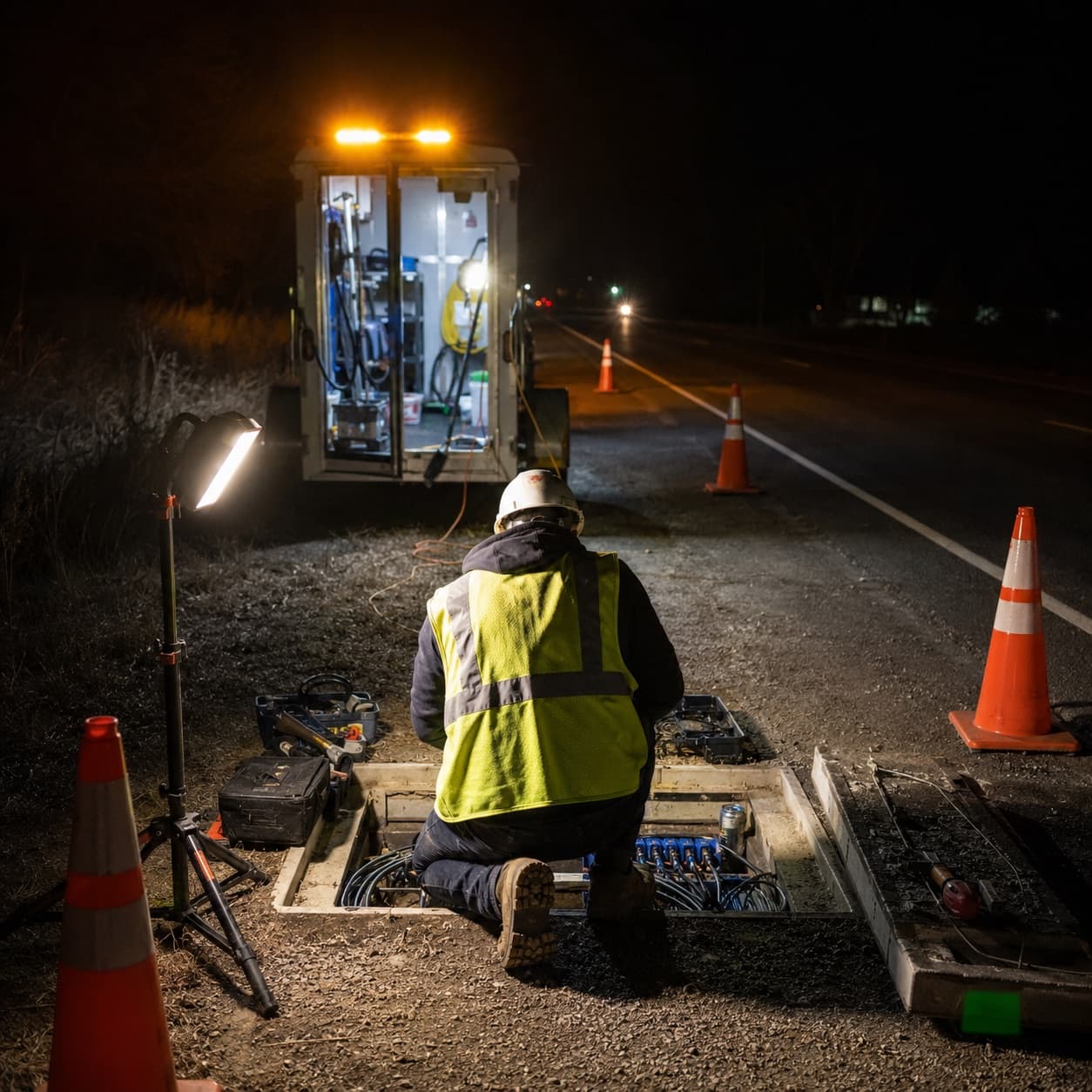
Utility contractors are the most common call. A directional bore, a trencher, or an excavator finds a line that was not where the locate said it was, and suddenly a crew that builds things needs someone who repairs them. We are not there to assign blame or file a damage claim. We are there to put the strands back together so the meter stops running.
Internet service providers call us when an outage lands outside their own crew's capacity or coverage. That might be a 3am fault on a segment three hours from their nearest splicer, a storm that produced more simultaneous breaks than they have trucks, or a repair that needs to happen while their people are already committed to a build. We work as an extension of your team, on your standards and your documentation.
Municipalities and campuses with their own fiber call when the plant that nobody has touched in a decade finally fails. Those jobs usually start as tracing before they become splicing, because the first real problem is that the as-builts are wrong. We do both, so the same crew that finds the fault fixes it.
What happens when you call
No portal, no ticket queue, no callback window. The sequence below is what actually happens between your call and restored service.
- 1
You call, a splicer answers
Any hour. We take the location, the approximate strand count, and the cable owner, then tell you a realistic mobilization time based on where our crew actually is right now.
- 2
We load and roll
The trailer carries closures, splice trays, pigtails, fusion splicers, and an OTDR. We match the kit to your cable before leaving so the repair is not paused waiting on hardware.
- 3
We locate and confirm the fault
On arrival we shoot the span from a known end to confirm exactly where the break is and whether there is a second one. A visible cut is not always the only damage in the trench.
- 4
We splice, test, and close out
Fusion splice the affected strands, verify every one with an OTDR trace, seal the closure, and hand you the test results so you have documentation of what was restored.
What emergency response covers
One crew handles the whole repair, from finding the fault to handing you the trace that proves it is fixed.
24/7 dispatch
Nights, weekends, and holidays. Outages do not keep office hours, and the emergency line is the same number as the main line so there is nothing to look up at 3am.
Cut and damaged cable repair
Dig-ins, aerial strikes, rodent and storm damage, crushed duct. Single strands through high-count ribbon, inside plant and outside plant.
Fault location
OTDR traces from a known end to pinpoint the break, plus a second look for the additional damage that often sits a few feet away from the obvious one.
Temporary restoration
When a permanent repair has to wait on daylight, materials, or a road closure, we can get traffic moving on a temporary splice and come back to finish it properly.
Fully stocked splice trailer
A climate-controlled workspace with fusion splicers, closures, trays, and pigtails on board, so the repair does not stall waiting on a supply run.
Test results in writing
Every restored strand is verified and documented, so you can close the ticket, satisfy the cable owner, and support a damage claim with real numbers.
Why contractors keep our number saved
Emergency work is judged on two things: whether you answer, and whether the person who shows up can actually do the splice. We built this crew around both.
- A splicer answers the emergency line, so the first conversation is technical rather than administrative.
- Senior-level splicers on every job. There is no junior crew to send, because we do not have one.
- Crews travel as a self-contained truck-and-trailer unit, so distance is a scheduling question rather than a hard boundary.
- We give you a realistic mobilization window and update it if it changes, instead of promising an arrival time we cannot control.
- Splicing is all we do. Emergency calls are not squeezed between other trades.
FAQ
Emergency Fiber Splice Repair questions
Still have a question? Call us any time at (651) 273-3065 and we'll walk you through it.
Call us first, then stop work at the dig site and leave the cable untouched. Do not pull, cut back, or tape the ends, because preserving slack keeps the repair to a single splice point. Have the location, the approximate strand count, and the cable owner ready when you call so we can load the right hardware before we leave.
Yes. The emergency line is staffed around the clock, including nights, weekends, and holidays, and it is the same number as our main line. The person who answers splices fiber for a living, so you can describe the damage in technical terms and get a useful answer on the first call.
It depends entirely on where our crew is when you call and where the damage is. Rather than quote a blanket response time we cannot honor, we tell you a realistic mobilization window on the phone based on our actual position that night, and we update you if it changes. What we commit to is mobilizing immediately.
The drive is usually the long part. Once we are on site, fault location takes minutes with an OTDR, and splice time scales with strand count: a handful of strands is quick, while a high-count ribbon cable is a multi-hour job. Access matters too, since a break in a flooded vault or under a road takes longer to reach than one in an open trench.
Almost always, yes. Most emergency calls are on plant we have never seen, often with as-builts that do not match what is in the ground. That is normal for this work. We trace and verify what is actually there rather than trusting the records, which is why tracing and splicing are handled by the same crew.
Yes. We document what we found and hand over OTDR test results for every strand we restore. That gives you a defensible record of the damage and the repair, which is what cable owners and insurers ask for after a dig-in.
Minnesota, North Dakota, South Dakota, Iowa, and Wisconsin are our routine footprint, and we are based in Hastings, Minnesota. Because our crews travel as a self-contained truck-and-trailer unit, we also mobilize nationally for the right project. If you are outside the Upper Midwest, call and we will tell you honestly whether we can get there in a useful timeframe.
24/7 Emergency Fiber Repair
Line down? Call. Everything else, send it over.
If fiber is cut and service is down, call now rather than filling out the form. We answer 24 hours a day and mobilize immediately. For contract splicing, testing, and build support, the form gets your scope to the right person.
- Emergency line answered 24/7, nights, weekends, and holidays
- Every splice OTDR verified and documented
- Upper Midwest based, mobilized nationally by project
Contract inquiry
Tell us the scope and the schedule and we'll come back with a straight answer.