

Fiber Testing & Tracing
OTDR testing, loss certification, fiber tracing, and fault location, so you know what your plant actually is and can prove it performs.
Find out what is really out there, then prove it works
Testing answers two different questions, and it is worth separating them. The first is whether a segment performs: does the loss across it fall inside budget, are the splices and connectors clean, and will it still pass in five years. The second is what you actually have: which strands are live, what is spliced to what, how far down the span each event sits, and why the drawing says one thing and the vault says another.
We do both, with the same crew and the same instruments. An OTDR trace tells us the distance to every event on a span, which turns a vague fault into a measured distance from a known end. Insertion loss testing tells us what the segment actually costs you in decibels end to end, which is what an owner accepts a build on. Fiber identification tells us which strands are carrying traffic, so nobody opens a case and cuts into a live one.
The most common version of this call is not a failure at all. It is an operator who inherited plant with records that were never maintained, and who cannot safely plan a new build, a lease, or a sale on top of documentation nobody trusts. That work is unglamorous and it pays for itself the first time it keeps a crew from cutting a strand the drawing said was dark.
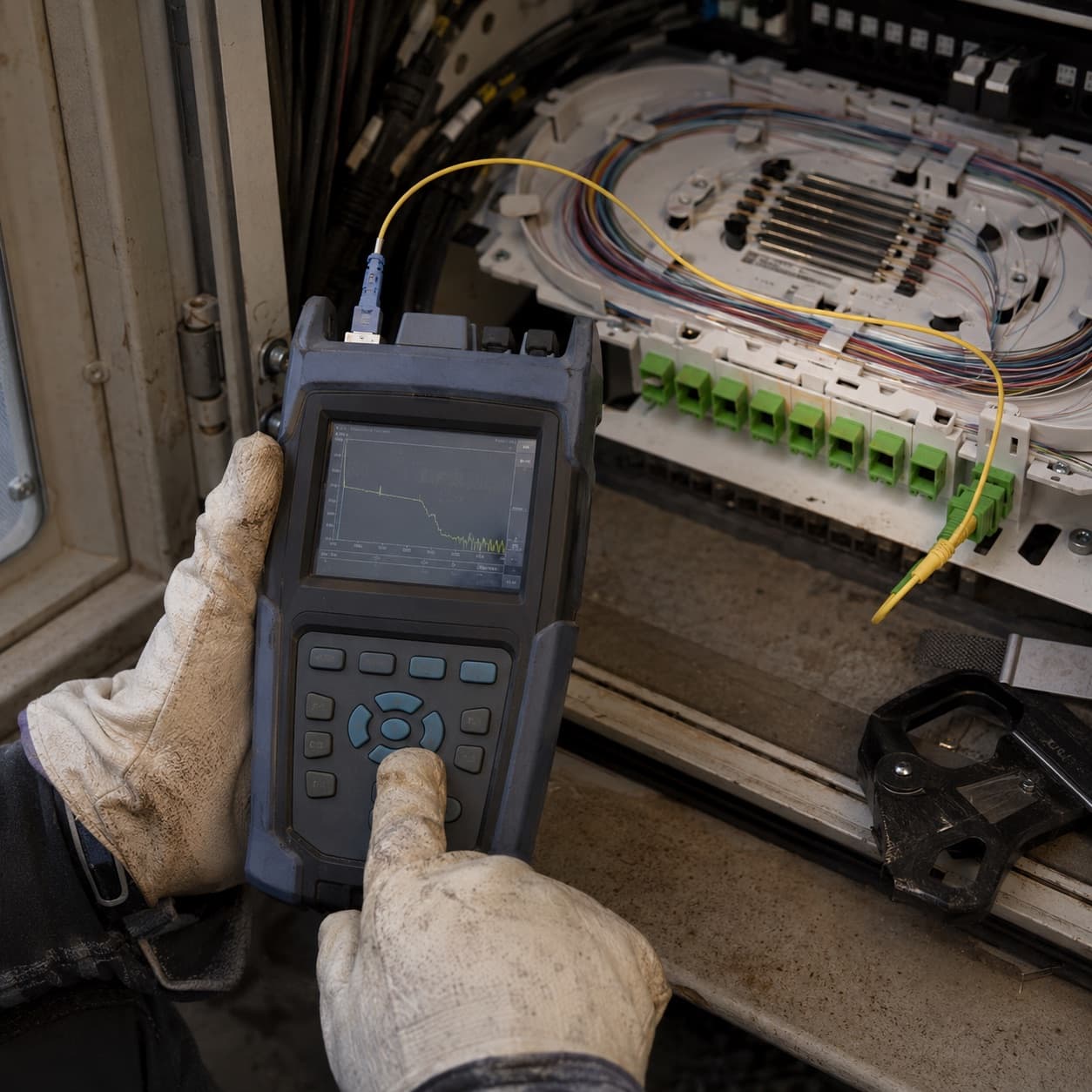
When testing is the thing standing between you and closeout
New builds need certification before anyone will accept them. If you are handing a segment to an owner, a lease customer, or your own operations team, the test record is the deliverable that ends the argument about whether the work is finished. We test to the standard you are being held to and give you results in a format you can forward without rewriting.
Existing plant needs testing when something is degrading rather than dead. Intermittent errors, a link that runs but keeps missing its budget, a segment that got worse after somebody else worked in the vault. Those are the hardest faults to chase by feel and the easiest to find with a trace, because the OTDR shows you the event and the distance instead of a symptom.
Acquisitions, leases, and municipal projects need this before anything else happens. When the as-builts are twenty years old and three contractors have been through since, the honest first step is finding out what the fiber actually is: which strands are live, what is spliced to what, and how each span measures. We would rather sell you that week of testing than sell you a build designed on top of a drawing that is wrong.
What testing and tracing covers
Instruments are the easy part. The value is in reading the results correctly and handing you records that survive being forwarded. Tracing here means tracing the fiber itself. Finding where a cable physically runs underground is a locate, and that is done on site by a utility locator.
OTDR testing
Bidirectional traces that show every splice, connector, bend, and break on a span, with distance to each event so a vague fault becomes a measured distance from a known end.
Insertion loss certification
End-to-end light source and power meter testing against your loss budget, which is what a segment gets accepted on.
Fault location
Chasing intermittent errors, high-loss events, and degrading links back to the specific splice, connector, or damage causing them.
Fiber identification
Confirming which strands are live and which are dark before anyone opens a case, splices, or plans a cutover on them.
Records reconstruction
Verifying what is actually spliced to what when the as-builts are missing, outdated, or contradicted by the vault.
Documentation you can forward
Results delivered in a format you can hand to an owner, a lease customer, or an insurer without reformatting them first.
Why the trace is only as good as the person reading it
Anyone can attach an OTDR to a fiber. Interpreting a messy trace on plant with unknown history is the part that takes years, and it is the part that decides whether the number you act on is right.
- Fiber specialists since 2015, on plant that ranges from new ribbon builds to legacy runs nobody has records for.
- The crew that traces the fault is the crew that splices it, so nothing is lost in a handoff.
- Results delivered as documentation, not as a phone call you have to take notes on.
- Senior-level technicians on every job, which matters most on the ambiguous traces.
- We tell you when the honest answer is that the records need rebuilding before the project should proceed.
FAQ
Fiber Testing & Tracing questions
Still have a question? Call us any time at (651) 273-3065 and we'll walk you through it.
An OTDR sends light down a fiber and measures what reflects back, which produces a trace showing every splice, connector, bend, and break on the span along with the distance to each one. You need it when you are certifying a new segment, when you are chasing a fault and need a measured distance rather than a guess, and any time you want a baseline record of plant you will own for years.
Yes, and most of our testing work is on plant we did not build. Testing inherited fiber is one of the more useful things an operator can do, because it establishes what you actually have before you plan a build, a lease, or a sale on top of it.
Yes. Tracing and records reconstruction is a regular part of our work. We verify which strands are live, what is spliced to what, and how far each event sits from a known end, then give you documentation that reflects reality rather than the drawing. On plant that has passed through several contractors, this is usually the correct first step before anything else is planned.
No. Finding a cable's physical path in the ground is a locate, and it is done on site by a utility locator with the equipment for it. Our tracing works on the fiber itself: which strands are live, what is spliced to what, and how far an event sits from a known end. Arrange the physical locate separately, and we will work from what the locator marks.
Yes. We perform insertion loss testing and OTDR verification against the loss budget you are being held to, and deliver the results in a format you can hand to an owner or lease customer. Tell us the standard you are certifying against when you call so we test to the right one.
Usually, yes, and it is a common reason people call. Intermittent errors and links that run but keep missing budget are hard to chase by feel and much easier to find with a bidirectional trace, because the instrument shows the event and its distance instead of just the symptom.
24/7 Emergency Fiber Repair
Line down? Call. Everything else, send it over.
If fiber is cut and service is down, call now rather than filling out the form. We answer 24 hours a day and mobilize immediately. For contract splicing, testing, and build support, the form gets your scope to the right person.
- Emergency line answered 24/7, nights, weekends, and holidays
- Every splice OTDR verified and documented
- Upper Midwest based, mobilized nationally by project
Contract inquiry
Tell us the scope and the schedule and we'll come back with a straight answer.